
A puppy that has raced around the living room for twenty minutes and still won’t settle is a common sight in a new owner’s house. The puppy isn’t broken. Running burns off some energy, but it does nothing for the part of a puppy that needs to think, sniff, and work something out. A puppy can be physically busy all day and still arrive at bedtime wired.
That is why low impact exercise for puppies is worth building into your day. These are games that tire the brain without pounding young joints, and most of them work fine indoors on a rainy afternoon.
Why a puppy can be physically busy and still never settle
Zoomies, mouthing your ankles, and tearing laps around the sofa are what an under-stimulated puppy tends to do. More running often makes the problem worse, because a puppy that gets fitter needs more and more to wear out. You end up with an athlete who still has nothing to do with their head.
Puppies also get overtired. A puppy that has missed a nap can look more hyper, not less, and it is easy to mistake that for a need for more activity. Often the puppy needs a calm task followed by sleep.
Mental work fills that gap. Sniffing, searching, figuring out a feeder, and short bursts of focused training all ask a puppy to concentrate, and concentrating is tiring. The games below take a few minutes each, cost very little, and fit around a normal day.
What I mean by low impact, and why I leave the exact limits to your vet
By low impact I mean activities with no hard running, no repeated jumping, no sharp turns at speed, and no long forced walks. The puppy moves around at their own pace and uses their nose and brain more than their legs.
I’m a long-time dog owner with a background in obedience, agility, and water work. I’m not a vet and I’m not a certified trainer, so I can’t tell you how much exercise your particular puppy should get. That depends on breed, size, age, and health, and your vet knows your puppy’s growth and condition in a way I can’t. Ask them at your next visit what suits your puppy, including when jumping, stairs, longer walks, and swimming are appropriate.
Everything below is a general idea to bring to that conversation, not a prescription.
Scatter feeding and sniff games you can set up in five minutes
Scatter feeding is the easiest place to start. Instead of putting dinner in a bowl, toss a handful of the puppy’s regular kibble across a patch of floor, a clean towel, or a patch of lawn. The puppy has to hunt every piece, and a meal that took thirty seconds now takes several minutes of nose work.
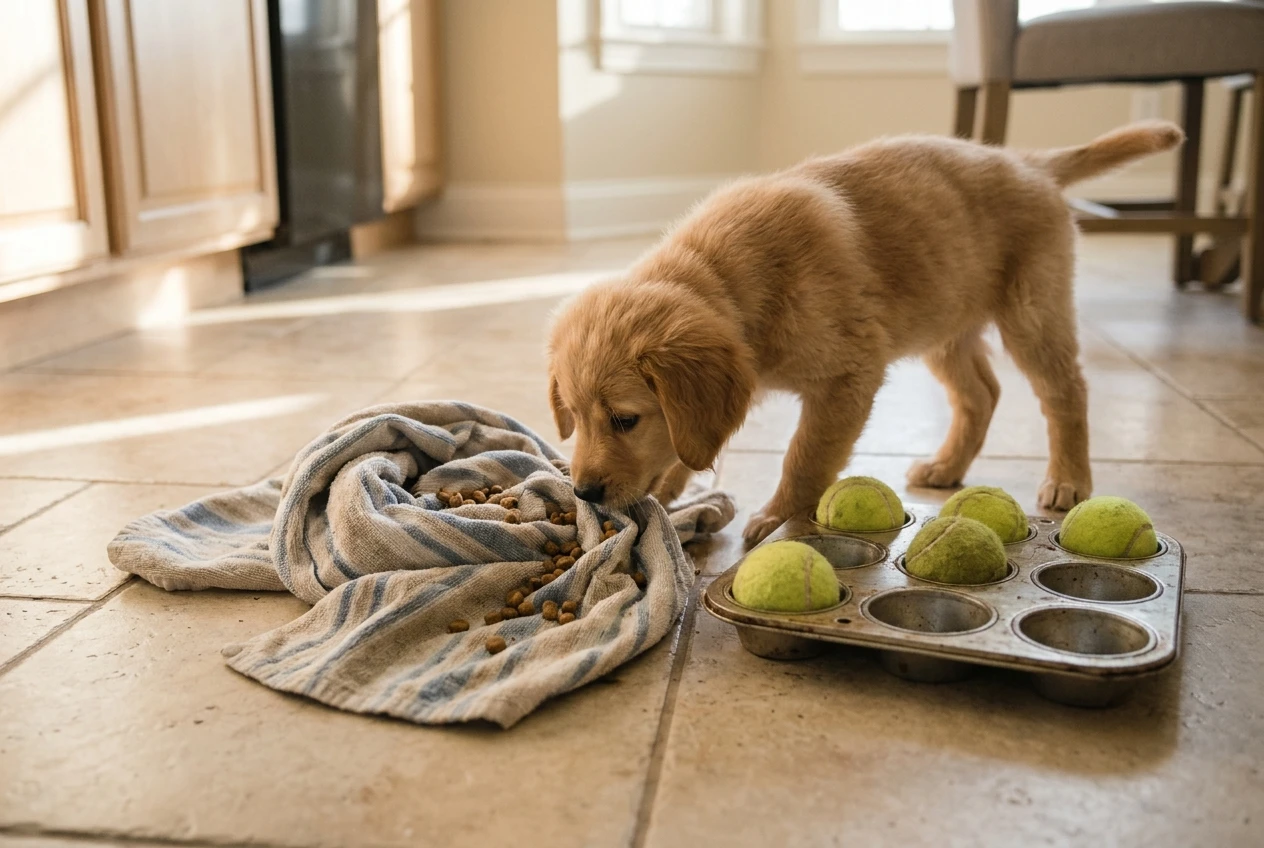
A few easy variations:
- Towel roll: Sprinkle kibble over a bath towel, roll it loosely, and let the puppy unroll it with their nose and paws.
- Cardboard box dig: Put a few treats in an open cardboard box with some crumpled paper, and let the puppy rummage. Keep an eye on them so paper is not swallowed.
- Muffin tin game: Place kibble in a few cups of a muffin tin and cover some with tennis balls or soft toys. The puppy has to figure out how to get at the food.
Use part of the puppy’s daily food ration for these games so you aren’t adding extra calories. Start with the food easy to see and make it harder gradually, so the puppy keeps winning and stays interested.
Hide-and-seek and find-it: teaching a puppy to use their nose
A puppy’s nose is far better at searching than their eyes, and a “find it” game gives them a job that plays to that strength. Once your puppy gets it, you can use it on almost any bored afternoon.
Start with the simplest version. Show the puppy a treat, say “find it,” and drop it a step or two away in plain view. When they eat it, repeat. After a handful of rounds, toss the treat where the puppy can’t see it land, such as behind a chair leg, and let them hunt.
When that is easy, move on to hiding treats around a room:
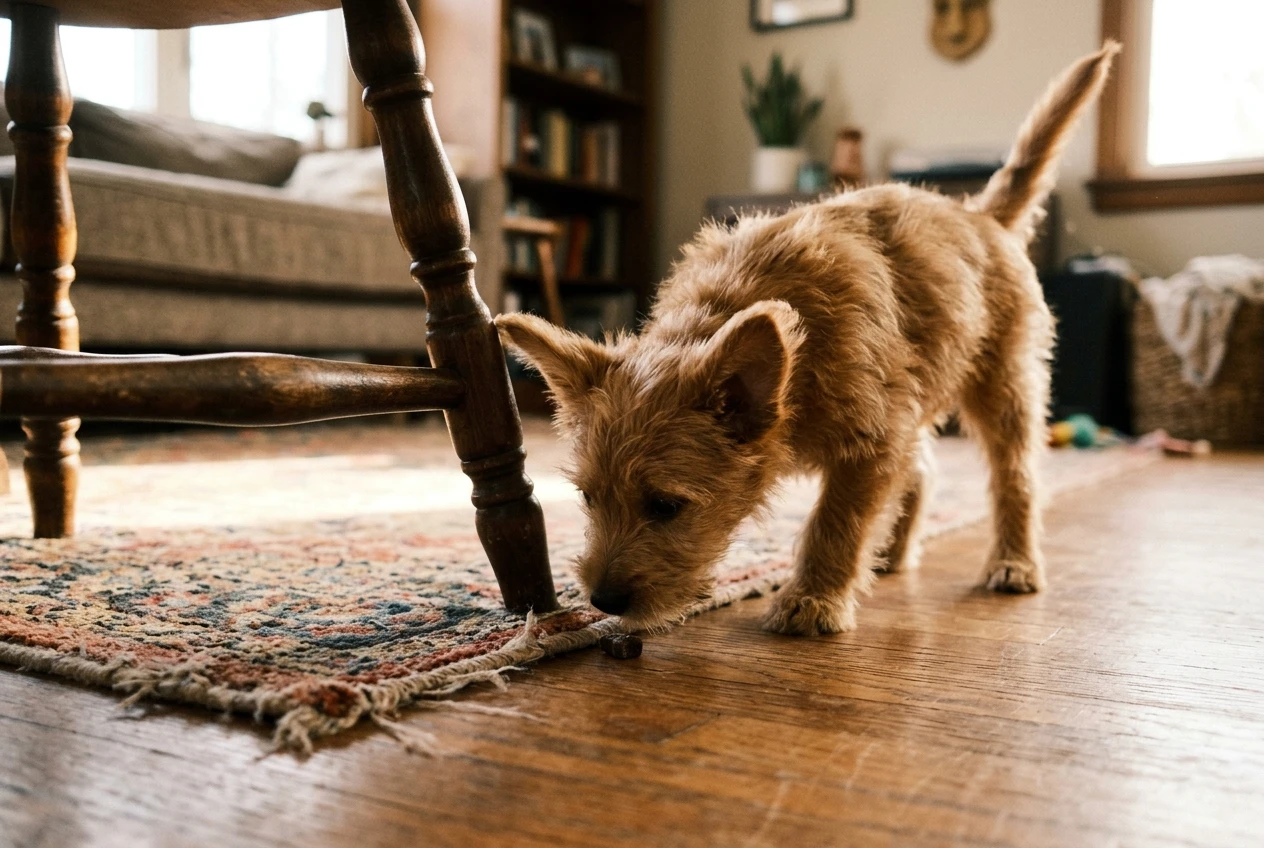
- Ask the puppy to wait, or have someone hold them gently while you hide three or four treats at floor level.
- Say “find it” and let the puppy search.
- Praise calmly when they find one, and stay quiet while they look so they can concentrate.
Keep the hiding spots low and simple at first: behind a door, under the edge of a rug, beside a table leg. Avoid high places that would encourage jumping up on furniture or climbing.
Hiding yourself
Once the puppy knows the word, you can hide too. Walk into another room, call the puppy, and reward them when they find you. This also builds a reliable recall, since the puppy learns that coming to you is the fun part. It’s a favorite in houses with children, provided everyone stays calm and quiet and the hiding places are easy.
Puzzle feeders, snuffle mats and chew toys that make mealtime work
If you only buy one thing for a bored puppy, a food-dispensing toy or snuffle mat is a sensible choice. These toys turn a meal into a project.
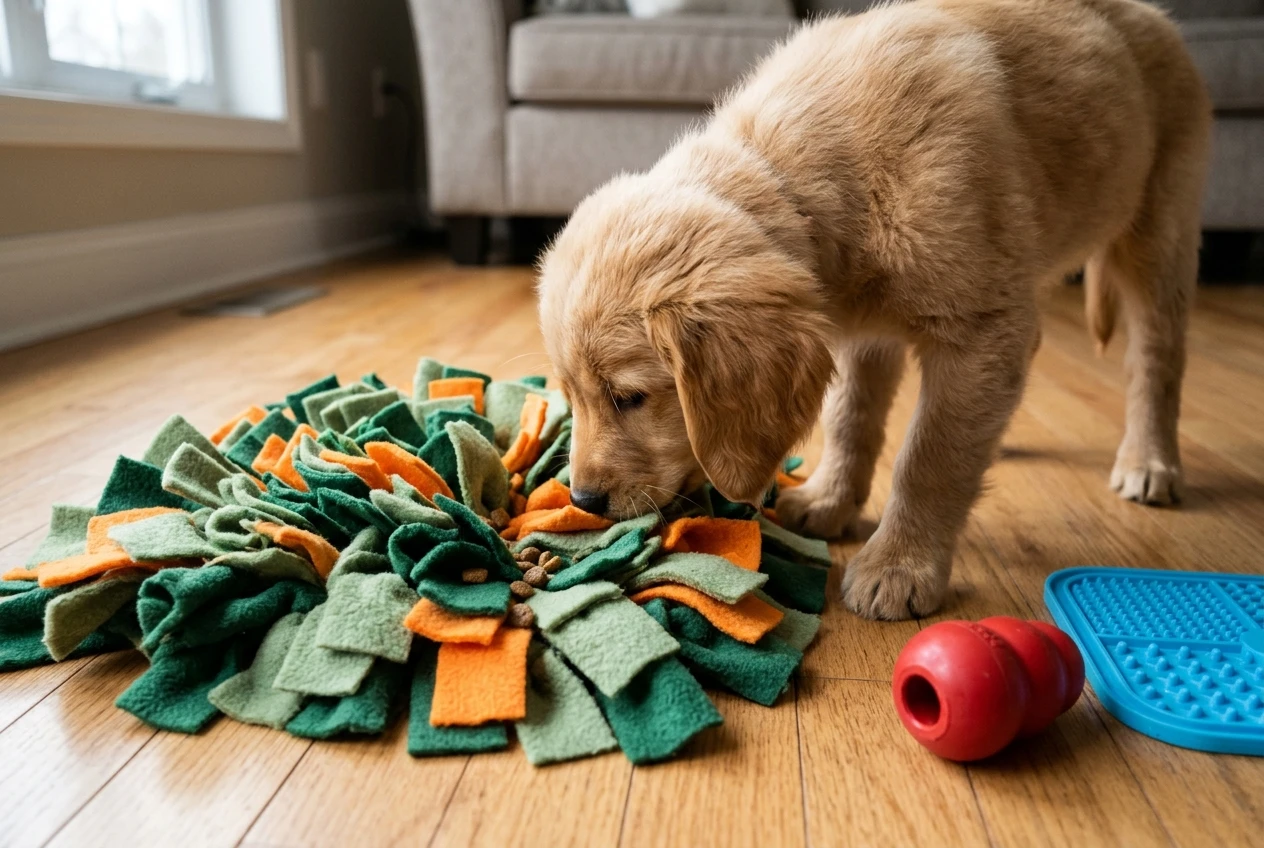
- Snuffle mats: Fabric mats with strips or fleece that hide kibble. The puppy sniffs and pulls the food out. They are a good first enrichment toy because they’re easy to understand.
- Puzzle feeders: Toys with compartments, sliders, or lids that the puppy has to work out. Start with an easy level and move up as they learn.
- Stuffable chew toys: Hollow rubber toys can be filled with a puppy’s usual food or other puppy-safe fillings. Check with your vet about which fillings suit your puppy.
- Lick mats: Spreading something puppy-safe on a textured mat gives a puppy a slow, soothing task, which is useful when you need them quiet.
Supervise a new toy at first, and look it over regularly for damage. Take it away if pieces are coming off, and choose a size that suits your puppy so it can’t be swallowed. When a toy is no longer a challenge, move to a harder one or change how you present it, for example by freezing a stuffed toy.
Short training sessions as a brain workout (and where the basic commands fit in)
Training is one of the best forms of mental exercise, and the sessions don’t need to be long. A puppy’s attention is short, so two or three brief sessions a day beat one long one. Stop while the puppy is still keen, not when they’ve lost interest.
The point here is not to teach a specific skill. It is to give the puppy’s head something to do. Even a command they already know, like sit, down, or touch your hand with their nose, makes them think about what you want and how to earn the reward. If you’re starting from scratch, the five basic commands I’d start any dog on are a good set to build these sessions around.
Some quick ideas for a five-minute session:
- Practice sit and down in a different room from usual.
- Teach “touch” by presenting your open hand and rewarding the puppy for bumping it with their nose.
- Reward calm behavior, such as lying down on a mat, by dropping a treat on it from time to time.
- Try a simple trick. If that appeals, there is a whole article on teaching your dog tricks.
Finish with something easy that the puppy knows well, so the session ends on a success. Then let them rest.
Gentle water play and slow, sniffy walks for puppies who need a change of scene
Some puppies do better with a change of scenery than with another game on the living room floor. Two options suit that without asking much of the joints.
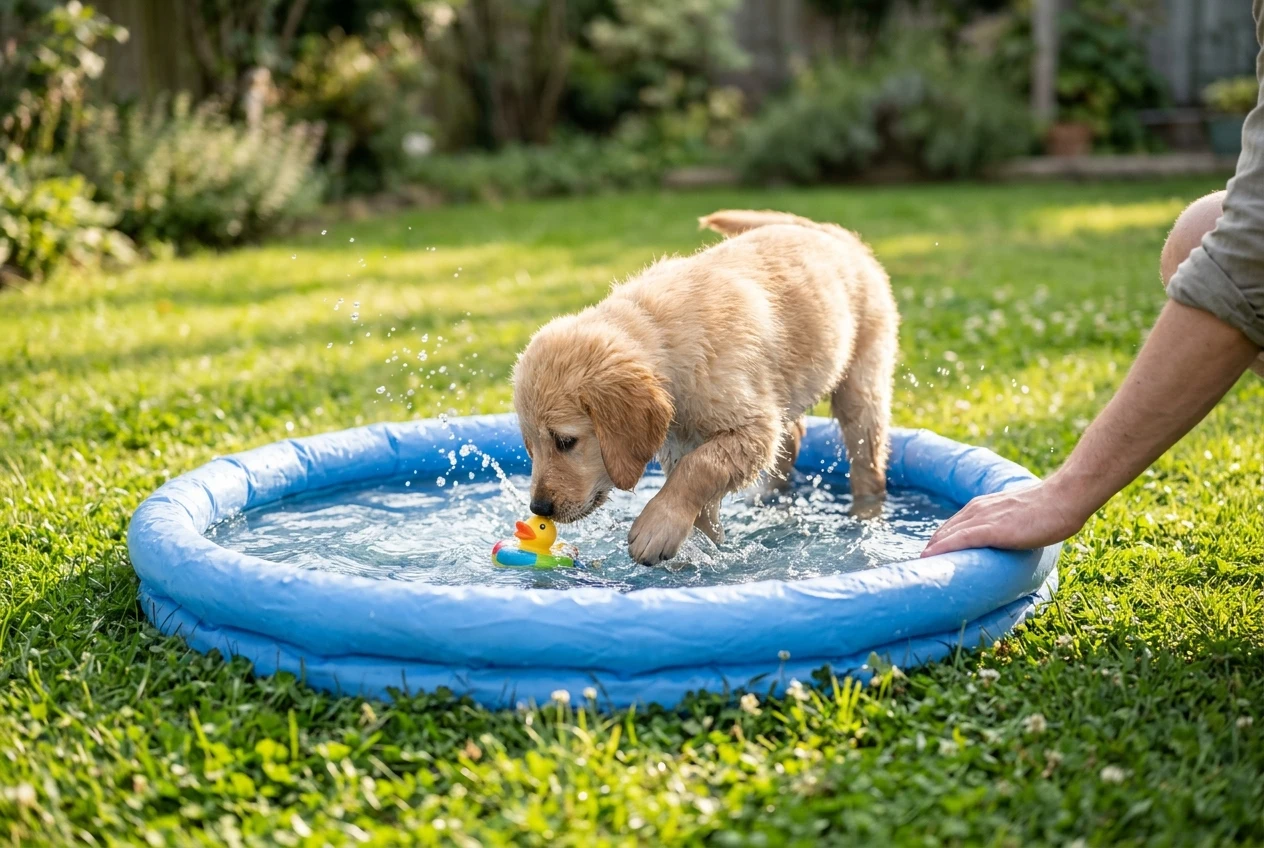
Gentle water play. Water work is something I’ve enjoyed with my own dogs over the years, and for a puppy it can start very small. A shallow paddling pool or a tray of lukewarm water a few inches deep, with a toy or a few treats floating in it, lets a puppy splash and explore. Stay right next to the puppy, never leave them alone with water, and keep the experience relaxed and optional. Ask your vet when your puppy is ready for lakes, rivers, or swimming, since that depends on the puppy and on vaccination status.
Slow, sniffy walks. A walk doesn’t have to cover distance. Let the puppy lead you at their own pace and stop to sniff whatever interests them. A short stroll where the puppy checks every bush and lamppost can be more satisfying to them than a brisk march, and it asks less of their body. Keep the route short, and take it somewhere that’s safe for a puppy who may not have finished their vaccinations. Your vet can tell you what is safe in your area.
Both ideas suit a puppy who is a little bored with the house but isn’t ready for anything strenuous.
How to tell your puppy is tired and ready for a nap, and a simple daily rhythm to try
A tired puppy tends to show it, though the signs vary from dog to dog. Common ones include slower movements, yawning, lying down in the middle of a game, losing interest in a toy they loved a minute ago, and getting grumpy or extra mouthy. That last one catches many new owners out, because an overtired puppy can look wound up when what they need is sleep.
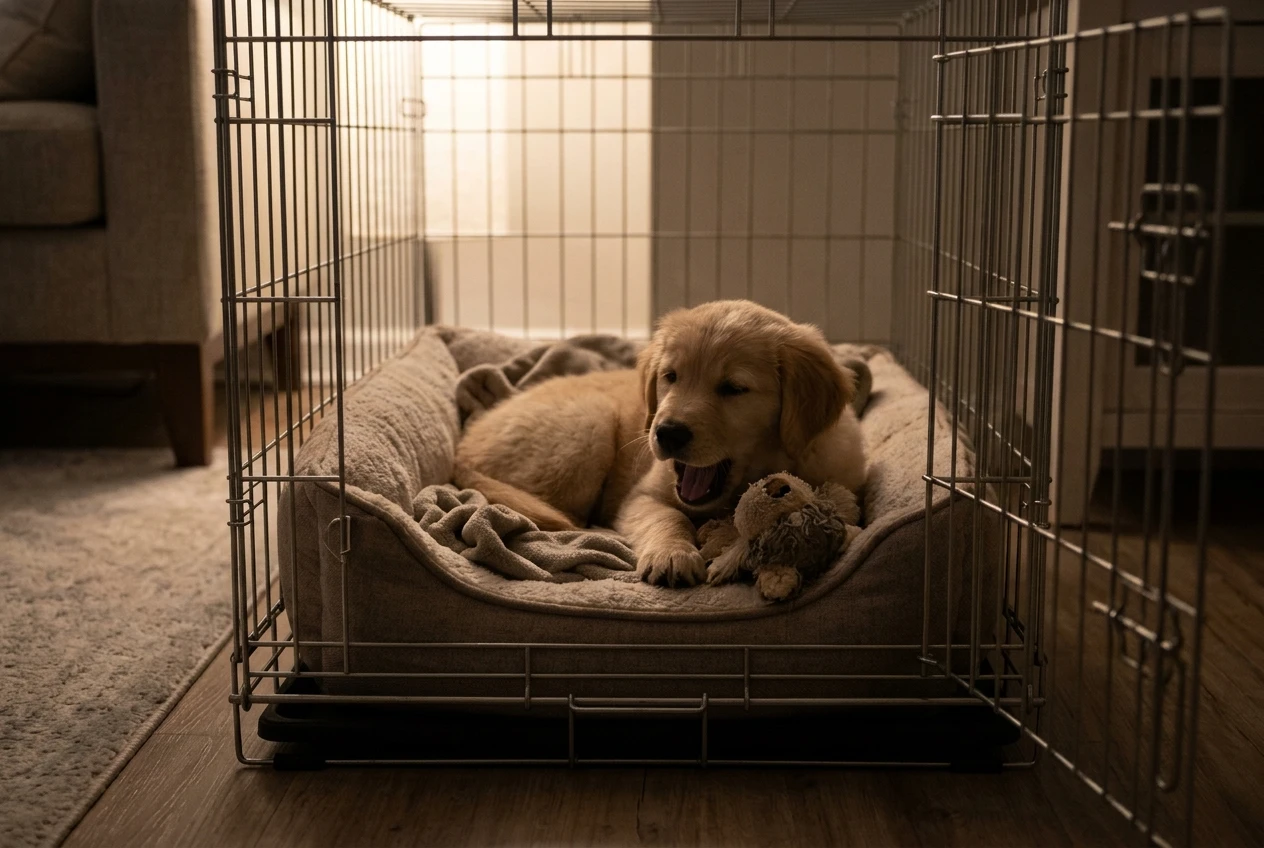
When you see these signs, end the game and let the puppy rest somewhere quiet, such as a crate or bed they know. Young puppies sleep a lot, so naps are normal and necessary, not a sign you’ve done something wrong.
Here is a simple rhythm to adapt, not a strict schedule:
- Morning: Meal as a scatter feed or in a puzzle feeder, followed by a short training session.
- Mid-morning: Nap.
- Late morning: A slow sniffy walk or a short find-it game.
- Afternoon: Nap, then a chew toy or lick mat while the household is busy.
- Early evening: A hide-and-seek round and a final short training session.
- Bedtime: A calm wind-down, then sleep.
Your puppy’s age, breed, and your own routine will shift all of this, and house training will shape the timing too. If you’re working on that as well, my four-step house training guide fits neatly around this kind of day.
Pick one or two enrichment toys, like a snuffle mat or puzzle feeder, to try with your puppy this week. If you want structured help turning that calmer energy into good manners, take a look at the online dog obedience classes.
Put the time into training your puppy don’t let him become one of these statistics!
“The single greatest cause of death in dogs under one year of age is not Parvo,
it’s not Distemper, it is lack of obedience training and 93% of training and
behaviour problems can be solved using a series of simple dog training techniques”