
If you’ve brought home a puppy or a newly adopted dog, you’ve probably noticed that the internet has a thousand opinions on how to teach your dog basic obedience commands. Most of them are right about something, and together they can leave you with no idea where to begin. This walkthrough gives you five commands in a sensible order, with short daily sessions and the mistakes that most often undo the work.
I’m a lifelong dog owner with a background in obedience, agility and water work. I’m not a certified trainer, and nothing here replaces an in-person professional if your dog has serious behavior problems. What follows is a plain method you can start tonight.
Why These Five Commands Come Before Anything Fancy
Sit, down, stay, come and leave it each do a specific job. Sit and down give your dog something to do instead of jumping, lunging or pestering. Stay gives you a pause button. Come brings your dog back to you. Leave it makes your dog let go of, or turn away from, something it shouldn’t have.
Three of those are about safety. A dog that comes when called can be stopped before it reaches a road. A dog that leaves it when told may drop a dropped pill, a chicken bone or a dead animal on a trail before it swallows it. A dog that holds a stay at an open door doesn’t bolt through it.
Tricks are fun, and I’ve covered them in a post on teaching your dog tricks. But a rollover won’t help in a parking lot. Teach the five first, because everything else, including agility and water work, builds on a dog that listens and can settle.
The order matters too. Sit teaches your dog how training works. Down and stay add calm and patience. Come and leave it are harder because they compete with whatever your dog finds more interesting than you, so they go last, once your dog already understands the game.
Before You Start: Treats, Timing and Ten-Minute Sessions
A little setup makes every command easier.
Treats. Use small, soft treats, pea-sized or smaller, that your dog can swallow in a second. Big or crunchy treats slow the session down while your dog chews. Keep a few tiers: ordinary treats for easy work indoors, and something your dog finds exciting for harder lessons like come. If your dog gets a lot of treats in a day, take that into account at mealtimes, and ask your vet if you’re unsure about portions or what suits your dog’s health.
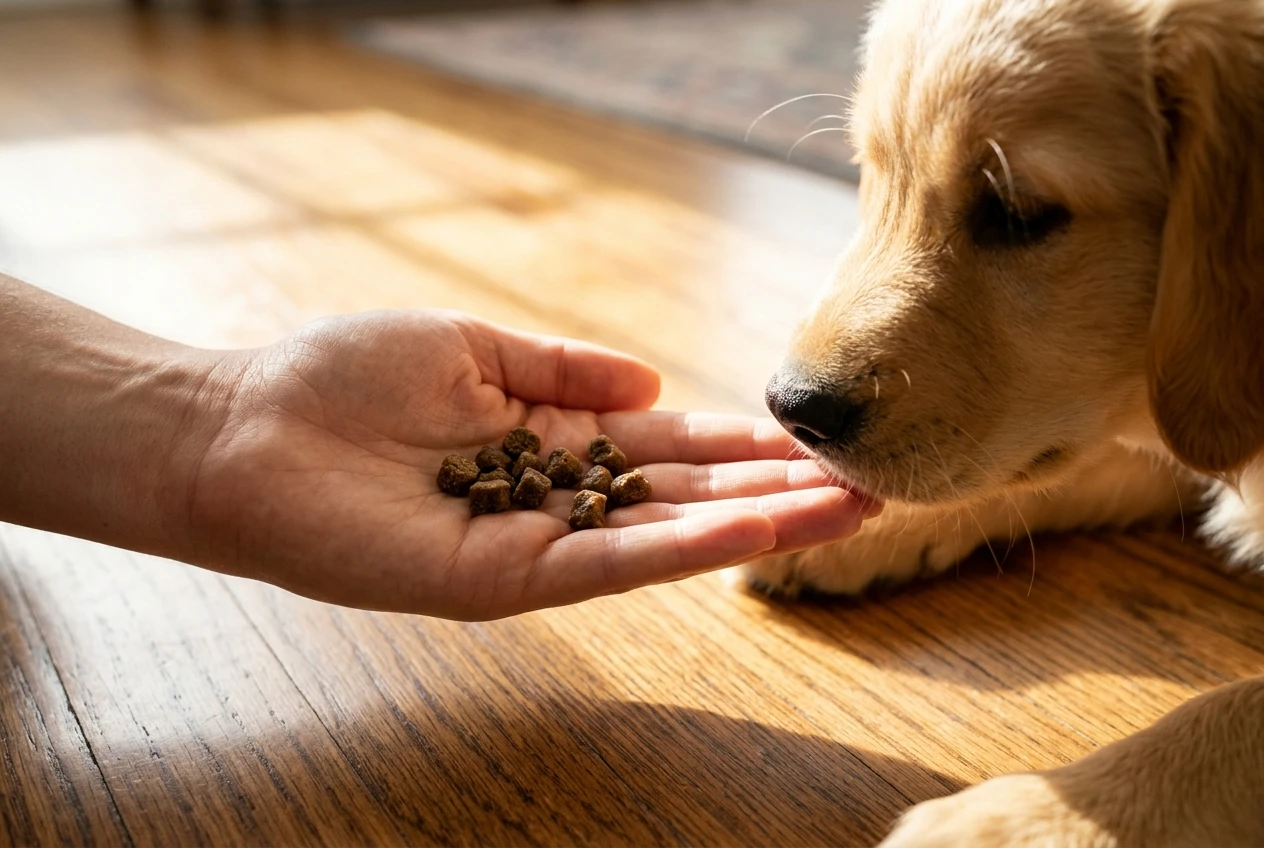
Timing. Dogs connect a reward to whatever they did a moment before it arrives. Pick a short marker word like “yes” and say it the instant your dog does the right thing, then give the treat. The word marks the exact moment of success. Your timing doesn’t need to be perfect, but a treat that arrives five seconds late rewards whatever your dog was doing in those five seconds.
Session length. Ten minutes is a good ceiling, and for a young puppy five is often plenty. Two or three short sessions a day beat one long one. Stop while your dog is still keen. A dog that gets tired, frustrated or bored in a session learns less and starts to dislike the game.
Place and mood. Start in a quiet room with no other pets, no television and no toys on the floor. Train before meals when your dog is a little hungry, not right after a big run when it’s wound up or exhausted. Keep your voice cheerful and your body relaxed.
One word per command. Use a single, short cue for each command and make sure everyone in the household uses the same one. If you say “sit” and your partner says “sit down” and your kid says “park it,” your dog hears three different words.
Sit: The Easy Win That Teaches Your Dog How Training Works
Sit is the best first command because it’s easy for the dog and quick for you. It also teaches your dog the pattern behind everything else: I do something, I hear the marker, I get a treat.
Here’s the method:
- Hold a treat close to your dog’s nose so it follows the scent.
- Slowly move the treat up and slightly back over its head. As the nose goes up, the rear end goes down.
- The moment its bottom touches the floor, say “yes” and give the treat.
- Repeat five or six times, then take a short break.
Don’t say “sit” yet. For the first several repetitions you’re just helping your dog get into position and learn that it pays. Once your dog is sitting smoothly every time you lure, say “sit” just before you move your hand. Over a few days, the word starts to predict the action.
Next, shrink the lure into an empty hand motion, then into a small hand signal. Then ask for the sit in different spots in the house: the kitchen, the hallway, next to the sofa. Dogs don’t automatically carry a lesson from one room to another, so changing the place is part of the teaching.
Once sit is solid, use it all day. Ask for a sit before you put the food bowl down, before you clip on the leash, before you open the door, and before you say hello to visitors. These everyday asks matter more than the formal sessions, because they teach your dog that sitting is how it gets what it wants.
If your puppy tends to leap at people, a reliable sit is also the best foundation for the fix I describe inhow to stop your puppy from jumping up.
Down and Stay: Building Calm and Duration One Second at a Time
Down is a more relaxed position than sit and is a good way to settle a dog at a café table, in a waiting room or while you eat dinner. Stay is what turns either position into a pause that lasts.
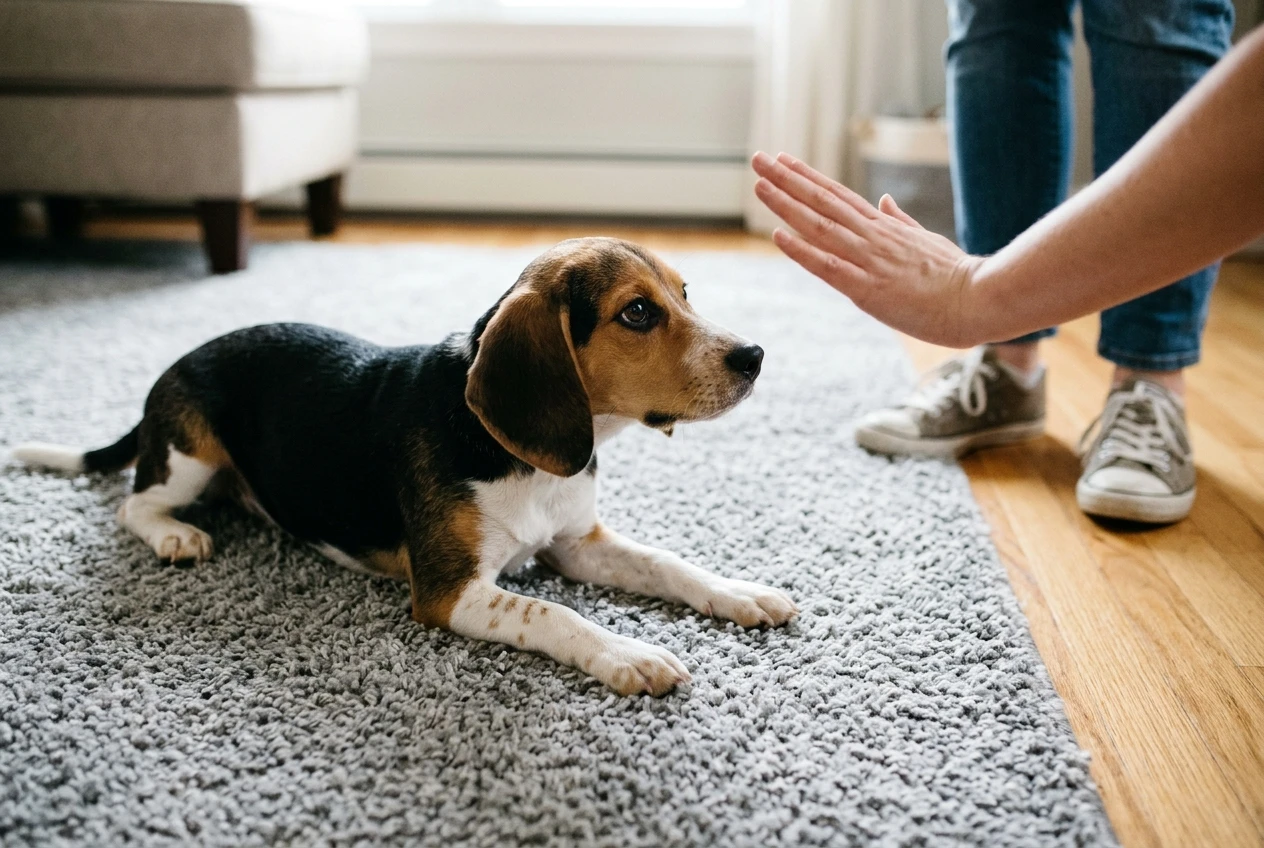
Teaching down
Start with your dog in a sit. Hold a treat at its nose, then lower your hand straight to the floor between its front paws. If its nose follows, slowly slide the treat forward along the floor, away from the dog. Its elbows should bend and its body should lower. The moment its elbows touch the ground, say “yes” and treat.
Some dogs resist this one, especially on a cold or slippery floor. A few things help:
- Train on a soft surface like a rug or a mat.
- Reward any small step toward the floor at first, such as a lowered head or a bent elbow, then ask for a little more each time.
- Don’t push your dog down with your hand. It makes many dogs tense, and the dog learns nothing about what you actually want.
As with sit, add the word “down” only when your dog is lowering smoothly, then fade the lure into a hand signal.
Teaching stay
Stay is built from three things: duration (how long), distance (how far away you are) and distraction (what’s going on around you). Increase only one at a time, and when you raise one, ease off the others.
Start with duration. Ask your dog to sit or lie down. Say “stay,” count one second, say “yes,” and give the treat right where the dog is. Then release it with a word like “okay,” which tells the dog it’s allowed to move. Without a release word, your dog decides for itself when a stay is over.
Build up gradually: two seconds, three, five, ten. If your dog breaks the stay, you’ve asked for too much. Go back to an easier number and build up more slowly. Breaking is information, and it doesn’t call for a scolding.
Only when your dog can hold a stay for around ten to fifteen seconds with you standing right next to it, add distance. Take one step back, return to your dog, treat, release. Then two steps. Always go back to the dog to deliver the reward. If you call it to you for the treat, the dog learns that stay ends the moment you’re ready for it to come, and it starts to anticipate that and break early.
Distraction comes last: a dropped toy, a family member walking past, a different room, the yard. Each new place or distraction resets the difficulty, so drop your expectations to the easy level and build again.
Come: The Command That Can Keep Your Dog Out of Traffic
Come is the most important command on the list, and it’s also the one dogs are most likely to ignore, because you’re competing with squirrels, other dogs and the smell of every bush on the block. That is why it’s built carefully.
Start indoors, a few feet from your dog. Say its name and “come” in a bright, happy voice, and as it approaches, show a treat. When it arrives, say “yes” and give the treat. Gently touch or hold its collar for a moment before the treat, so that being caught is never a bad thing. Then release it to go back to what it was doing.
Practice the following:
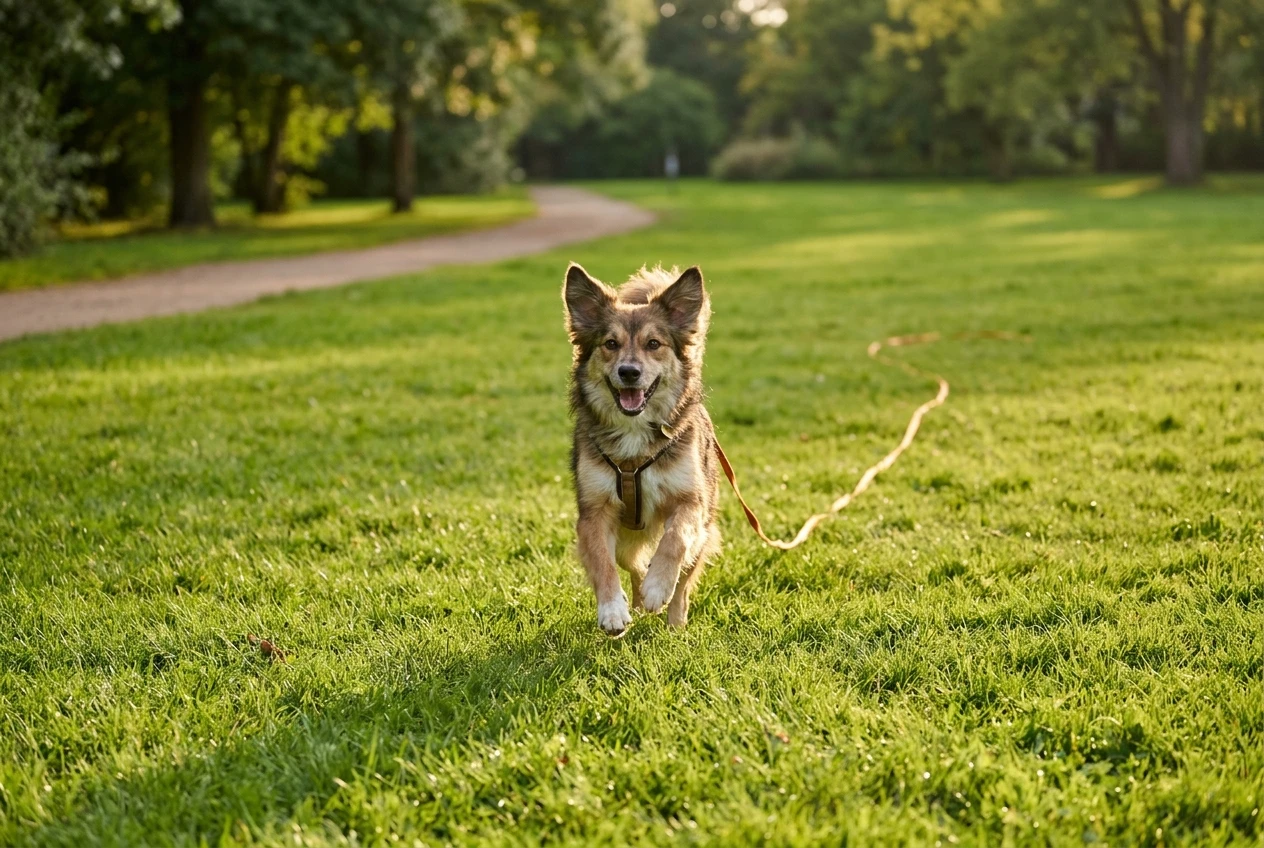
- Make it a game. Two people sit at opposite ends of a hallway and take turns calling the dog back and forth, rewarding each arrival.
- Use your best treats. Pay far better for come than for sit. A dog that returns from something exciting should get something more exciting.
- Be worth coming to. Don’t make a habit of calling your dog only when the fun is ending. Call it sometimes, reward it and send it right back to play.
- Never call your dog to scold it. If it comes to you and then hears an angry voice, you’ve just taught it that coming means trouble.
Once it’s reliable indoors, move to the backyard, then to a quiet park. Outdoors, use a long line, a lightweight leash of fifteen to thirty feet, so your dog has room to roam but can’t run off if it ignores you. Don’t test come off-leash in an unfenced area until your dog has proven itself in many places over a long time. Even then, some dogs are never fully dependable around traffic, wildlife or a strong prey drive, and a leash or a fence is the safer answer.
One more point: say “come” once. If your dog doesn’t respond, don’t keep repeating it. Make a happy noise, back away, crouch down or gently reel in the line.
Leave It: Stopping Your Dog Grabbing the Thing It Shouldn’t
Leave it means “don’t touch that, and look at me instead.” It’s useful for dropped food, trash on a sidewalk, socks, medication on the floor and the neighbor’s cat.
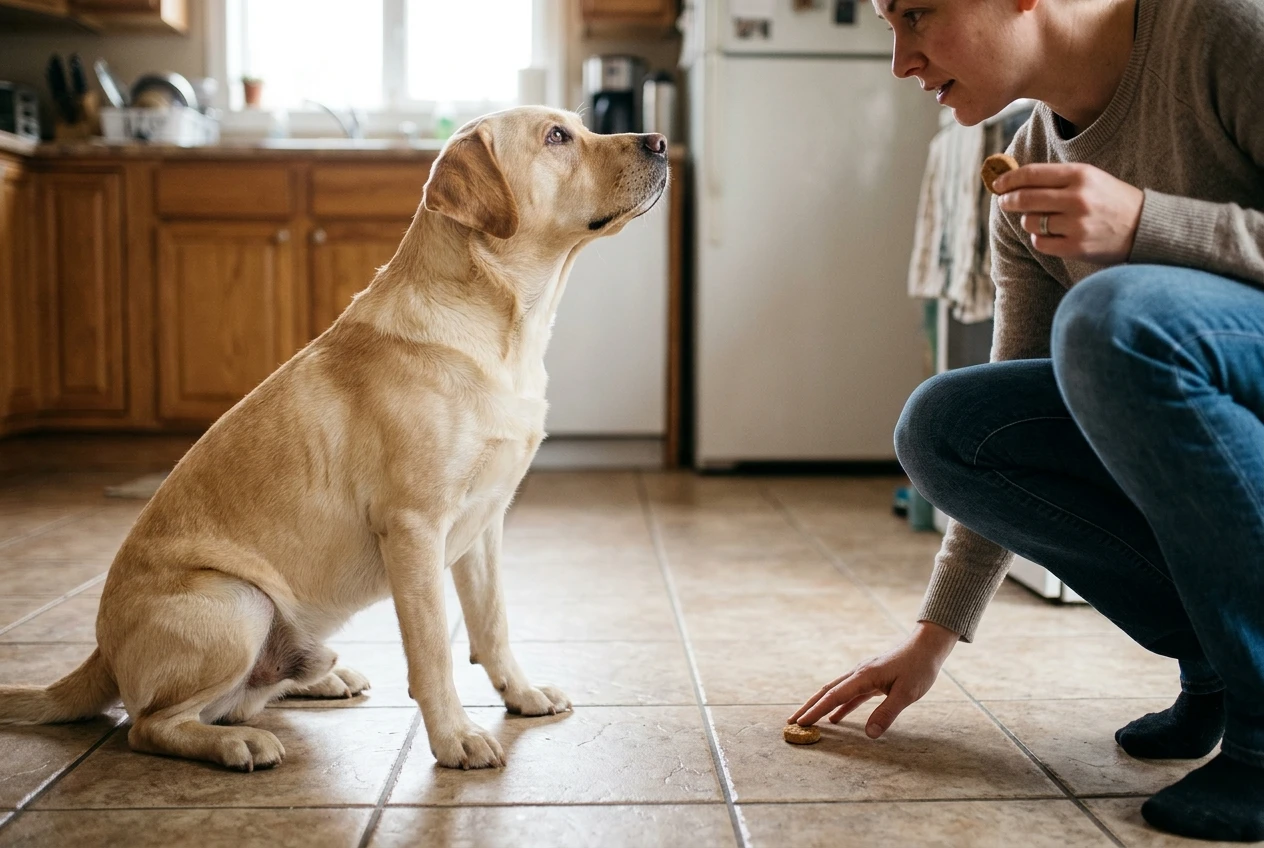
Start with a treat in a closed fist. Hold it near your dog’s nose. It will sniff, lick and paw at your hand. Wait. The moment your dog pulls its nose away, even for a second, say “yes” and give it a different treat from your other hand. This detail matters: the reward never comes from the thing you asked it to leave alone. It comes from you.
Next, add the words: say “leave it” just as your dog starts to back off. Then raise the difficulty in small steps:
- Put a treat on the floor and cover it with your hand. Reward when the dog backs off.
- Hold the treat on the floor uncovered, ready to cover it if your dog lunges.
- Drop a treat from waist height while standing on it or ready to block it.
- Use more tempting items, like a favorite toy or a piece of chicken.
- Practice on walks with real-life distractions, keeping your dog on the leash.
If your dog does grab something dangerous, don’t chase it. Chasing turns the moment into a game of keep-away. Trade it for a better treat instead, and if you think it swallowed something harmful, call your vet.
Where First-Timers Go Wrong
Owners at every experience level make these mistakes. Knowing them in advance saves weeks.
Repeating yourself. “Sit. Sit. Sit. SIT.” teaches your dog that the first three don’t count. Say the cue once, wait a few seconds, and if nothing happens, help your dog get into position and try again. Over time it learns that one request means one chance.
Rushing. Moving to distance, distraction or a new place before the current step is solid is the most common reason a command works at home and fails everywhere else. If your dog gets it wrong two or three times in a row, make the task easier.
Training only indoors. A dog that sits perfectly in the living room may act as if it has never heard the word in the driveway. Take each command to new places, starting with easy ones, and be prepared to go back a step each time.
Inconsistent rules. If the sofa is off-limits on Monday and fine on Tuesday, your dog can’t learn what you want. Everyone in the house should use the same cues, the same release word and the same standards.
Rewarding too little, too soon. Reducing treats too early is tempting, because you don’t want to carry food forever. Keep paying well while a skill is new, then reward less often once it’s reliable. Praise, a game or access to something your dog wants are good rewards, too.
Training when you’re frustrated. Dogs read your mood. If you’re irritated, stop the session, give your dog an easy win and try again later.
If house training is the problem keeping you up at night, I walk through it separately in how to house train a puppy in four steps.
Keeping the Commands Sharp as Your Dog Grows
Training doesn’t end when your dog performs on cue in the kitchen. Adolescence, roughly the months after puppyhood, is when many dogs seem to forget everything, and it helps to expect that. Go back to shorter distances, higher-value treats and calmer places, and be patient. The skills usually come back faster than they were learned the first time.
A few habits keep the five commands working:
- Fold them into daily life: sit for dinner, down while you drink your coffee, stay at the door, come when you call it in from the yard.
- Practice a few repetitions during walks, not just at home.
- Switch to occasional rewards once a command is reliable, keeping the unpredictable payoff exciting.
- Rotate the places you practice, including busier ones as your dog matures.
Physical exercise helps too. A dog that gets enough walks, play and mental work is much easier to teach, because it can focus on you instead of burning off energy. Enrichment toys, such as food puzzles, give a bored dog something useful to chew on while you get on with your day.
A class can be a good idea if you feel stuck, if your dog is fine at home but ignores you around other dogs, or if you simply want a second pair of eyes on your timing. An instructor can spot small errors in how you hold a treat or when you say “yes” that are hard to notice yourself. Classes are also a controlled way to practice around distractions, which is the hardest part of any command.