
House training is the first big test most new puppy owners face, and it tends to arrive when you are already short on sleep. The puppy is adorable, the floor is wet, and it can feel like every other owner has this figured out. They don’t. A puppy is a small animal with a small bladder, no idea what your house rules are, and a body that sends very little warning before it needs to go.
Reading about how to house train a puppy usually turns into a pile of tips: use a bell, use a pad, take them out every hour, never take them out too often. A pile of tips is hard to follow when you are tired. A short structure you repeat every day is easier. This article gives you one in four steps: set a schedule, supervise, reward, and reset after accidents.
As a lifelong dog owner, I’m sharing what I know from living with dogs, not speaking as a certified trainer. If your puppy has a medical problem or you are worried about something you are seeing, your vet is the right person to ask.
Why house training feels so stressful, and why it is not a sign you are doing it wrong
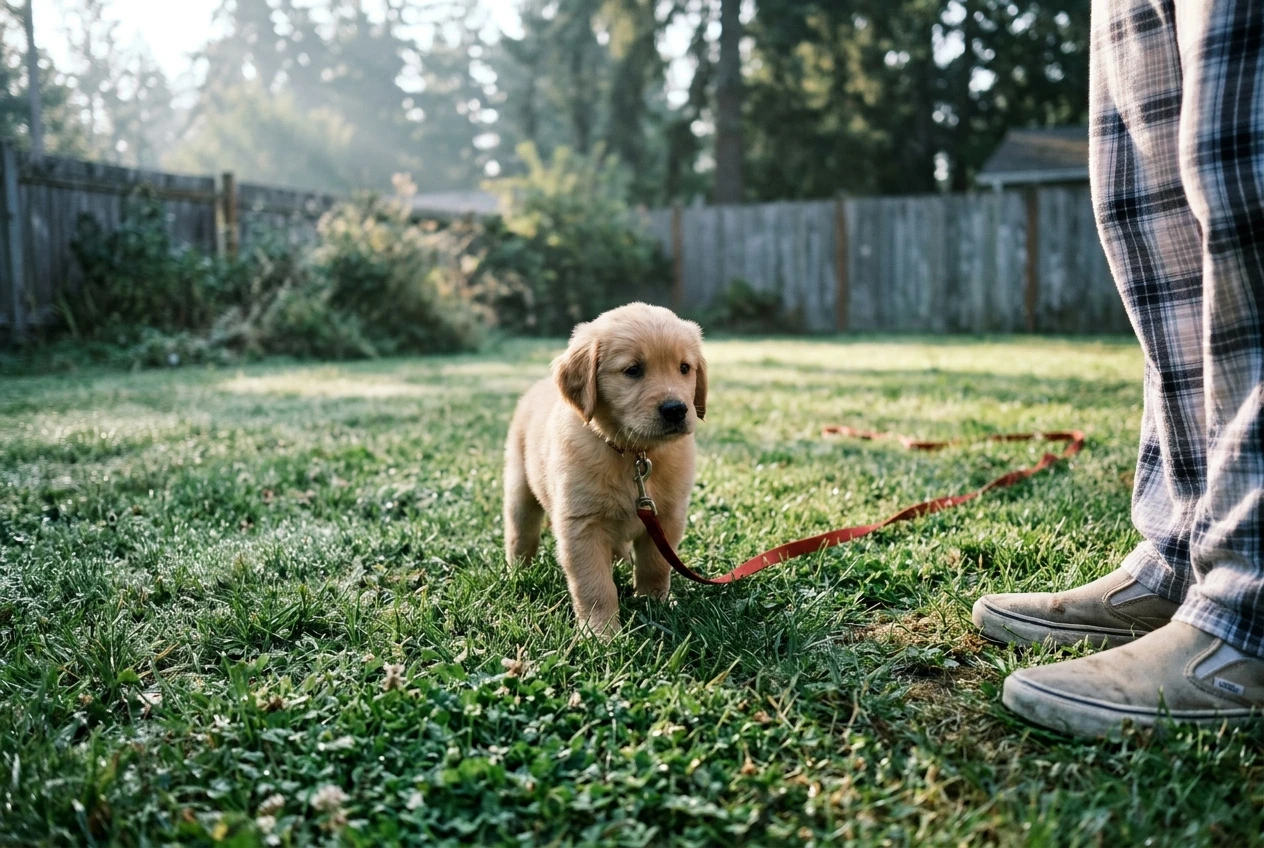
Accidents in the house are normal in a young puppy. Puppies have limited bladder control, and that control develops over weeks and months. They also don’t arrive knowing that grass is the bathroom and your living room rug is not. You have to teach that, and teaching takes repetition.
The stress comes from a few predictable places. Accidents feel personal, as though the puppy is doing it on purpose. They aren’t. Cleaning is unpleasant and constant. And advice online is often contradictory, so you can’t tell whether a setback means a mistake on your part or just a puppy being a puppy.
The shift that makes the biggest difference is treating each accident as information. If your puppy goes on the floor, something in the routine gave them the chance: they were not watched, the last trip was too long ago, or they were too excited to finish outside. That is a fixable detail in the plan, and it says nothing about your puppy’s character or your ability.
The four steps below are built around that idea. You control the schedule and the environment, and the puppy’s job is to keep practicing in the right spot.
Step 1: Build the daily rhythm
Puppies thrive on predictability, and a predictable day makes their bathroom needs predictable too. The goal of this step is to stop guessing. Instead of wondering whether your puppy needs to go, you build the trips into the day so most accidents never get the chance to happen.
Most puppies need to go at the same few moments:
- Right after waking up, including after naps
- Shortly after eating or drinking
- After a play session or a burst of excitement
- Before being left in a crate or pen, and before bed
That means a typical cycle goes: wake, potty trip, play, potty trip, meal, potty trip, nap, and then it starts again. It sounds like a lot of trips because it is. Young puppies can only hold it for short stretches, and those stretches get longer as they grow.
Feed on a schedule
Meals at set times make potty times easier to predict. Leaving food out all day makes it harder to know when your puppy will need to go. Check your puppy’s food packaging or ask your vet how much and how often to feed at their age, since that varies by breed and size.
Take them out the same way every time
Walk your puppy to the same spot, on a leash if you don’t have a fenced yard, and stay with them. Use the same short phrase each time, something like “go potty,” said calmly and not repeated over and over. Stand still and keep things boring for a few minutes. If your puppy wanders off to sniff and play, they are not finished learning that this spot is for business. Bring them back to the spot and wait.
If they go, great, and Step 3 tells you what to do next. If they don’t go after a few minutes, bring them inside and keep a close eye on them for a short while, then try again. A puppy who didn’t go outside and is now loose in the house is the most common setup for an accident.
Plan the nights too
Very young puppies often need a trip during the night. Setting a quiet alarm for it is better than waiting for the whining to start, because it keeps the night trip calm and short. Keep the lights low, skip the play, take them to the spot, and go straight back to bed. Over the weeks, the gap between night trips can grow, and your vet can help you judge what is reasonable for your puppy’s age.
Step 2: Supervise closely and set up your space so success is easy
This is the step most people underestimate. A puppy who has the run of the house will have accidents out of sight, and you can’t redirect what you can’t see. House training works best when the puppy is either being watched or safely contained.
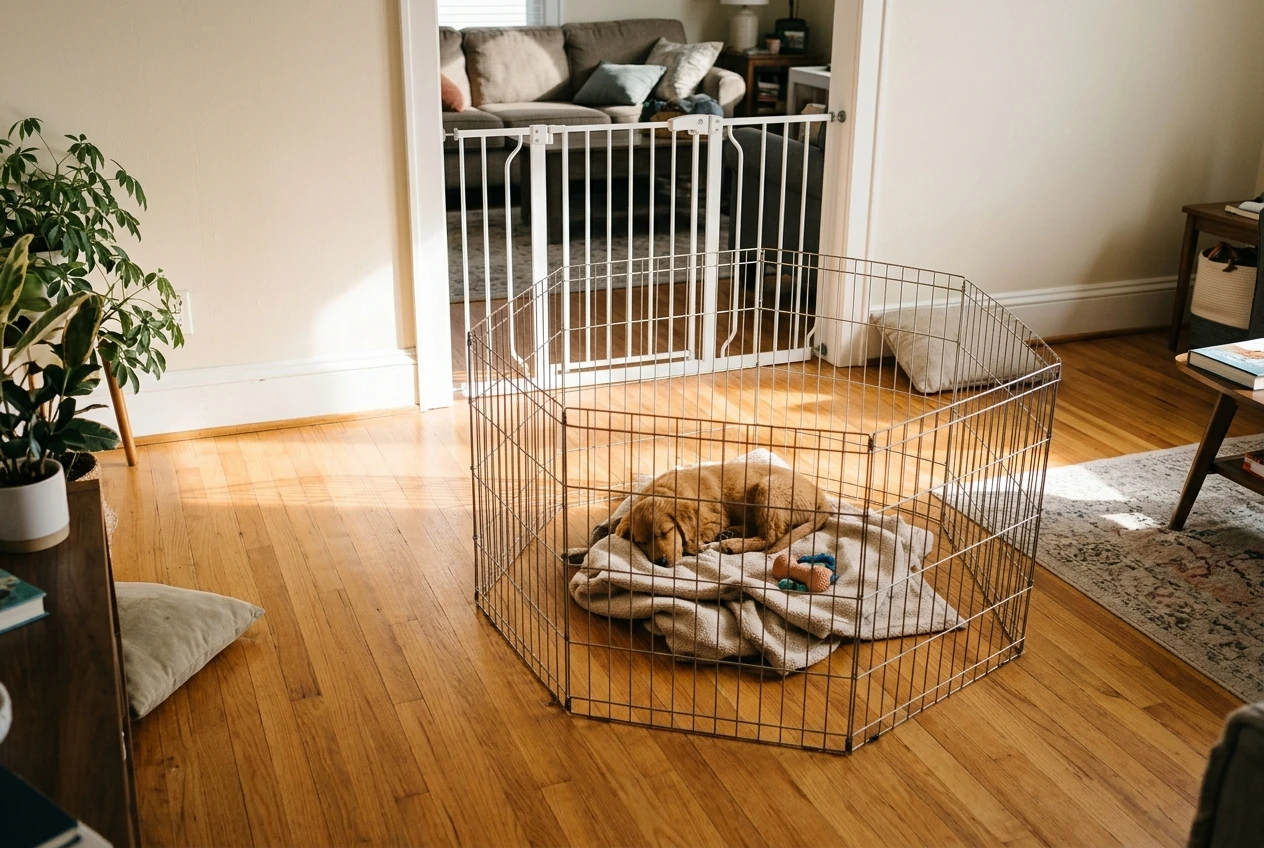
Two modes: watched or contained
When your puppy is out and loose, someone’s eyes are on them. Staying in the same room works, and some owners keep a leash attached to themselves indoors so the puppy can’t slip off. When you can’t watch, whether you are cooking, showering, or on a call, the puppy is in a crate or a small pen with a toy.
Watching a puppy closely teaches you their signals. Common ones are sniffing the floor in circles, suddenly stopping play, heading toward a door or a corner, or whining. When you see one, calmly pick them up or lead them straight outside. Doing this a handful of times starts to show you the pattern for your particular puppy, because each one has its own tells.
Shrink the space
Instead of giving a puppy a whole floor to explore, limit them to one or two rooms using baby gates or a playpen. Smaller space means fewer hiding spots for accidents and fewer places for you to lose track of them. You can open up more of the house gradually as the accidents stop, one room at a time.
Use the crate as a resting place
Many dogs do not like soiling the space where they sleep, which is why crates are a popular house training tool. The crate should be big enough for the puppy to stand, turn around, and lie down, and no bigger, since too much room can let them use one end as a toilet. A crate is not a place for punishment or for leaving a puppy for long hours. It is a bed with walls, and you can build up the time slowly with treats and calm routines.
If you notice your puppy panicking or distressed when left alone, that is a different issue from house training. It could be separation anxiety, which we will cover later in this guide.
Step 3: Reward the right spot, right away
Puppies learn by connecting what they do with what happens next. If peeing outside is followed by something wonderful, they are more likely to do it again. Timing matters a great deal here, because a puppy links the reward to whatever they were doing in the last couple of seconds.
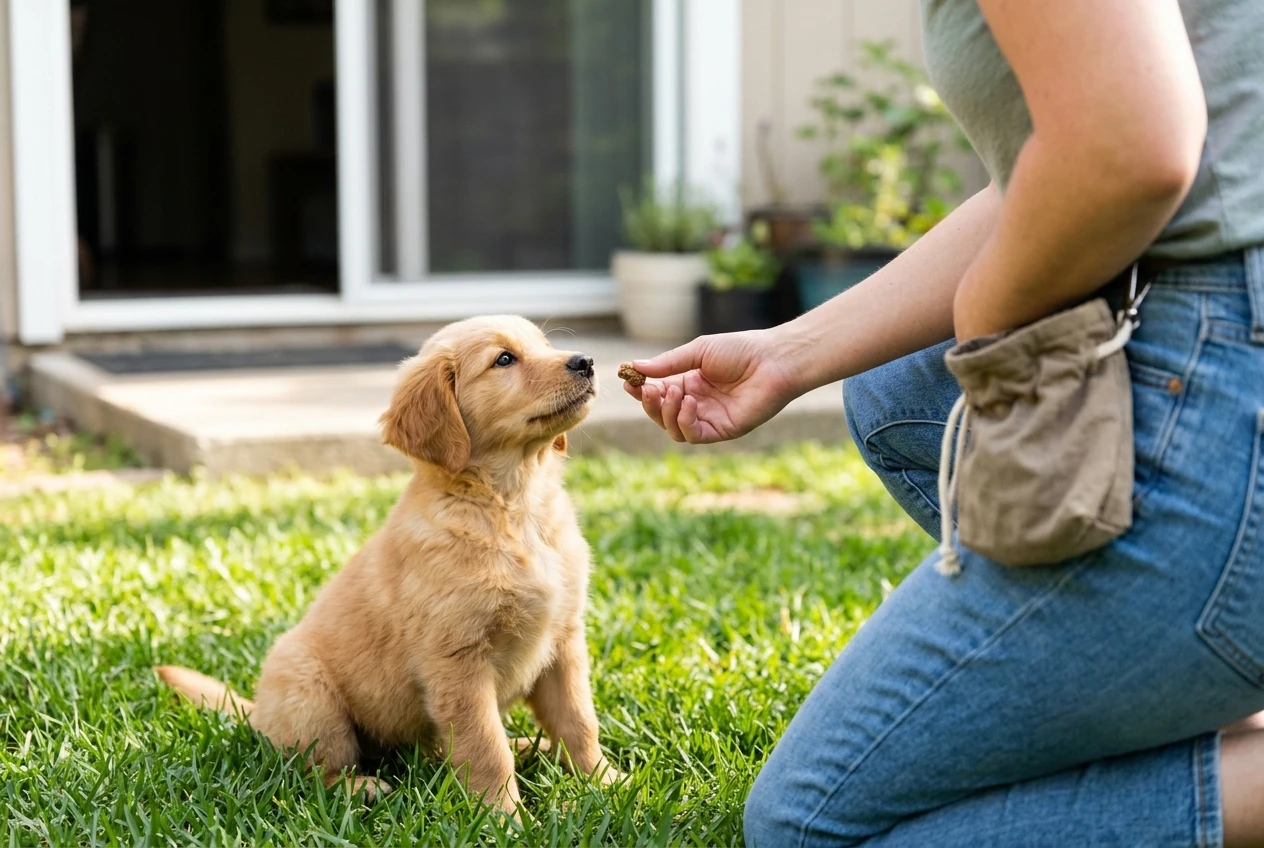
Reward in the moment
When your puppy finishes going in the right spot, praise them calmly and give a small treat right there, before you walk back toward the house. If you wait until you are inside, the puppy may connect the treat with coming in rather than with going outside. Keep a few small treats in a pocket or by the door so you are never fumbling for one.
Some owners add a play session or a short walk after the bathroom trip as a second reward. This works well because it keeps the puppy from learning that finishing quickly means the fun ends. If a puppy figures out that going outside means the end of outdoor time, they may start holding it to stay out longer.
Pick treats that suit the job
Treats for training should be tiny, soft, and easy to swallow fast. Your puppy’s regular kibble can work if they like it, and it saves calories. If the puppy needs something more exciting during the early weeks, a small piece of something special reserved only for potty success gives it extra weight. If your puppy has a sensitive stomach or dietary needs, ask your vet before adding new foods.
Keep your voice calm
Excited praise is fine, but a big, loud celebration can distract a puppy mid-business. Praise after they are done. Quiet and steady works better than wild and noisy, especially with puppies who get overstimulated easily.
While you are trying to decide how to train your dog overall, it helps to know that most methods are reward based, so what you are doing here fits right in.
Step 4: Clean up, reset and learn from accidents without scolding
Accidents will happen. How you handle them decides whether they slow the process or just get cleaned up and forgotten.
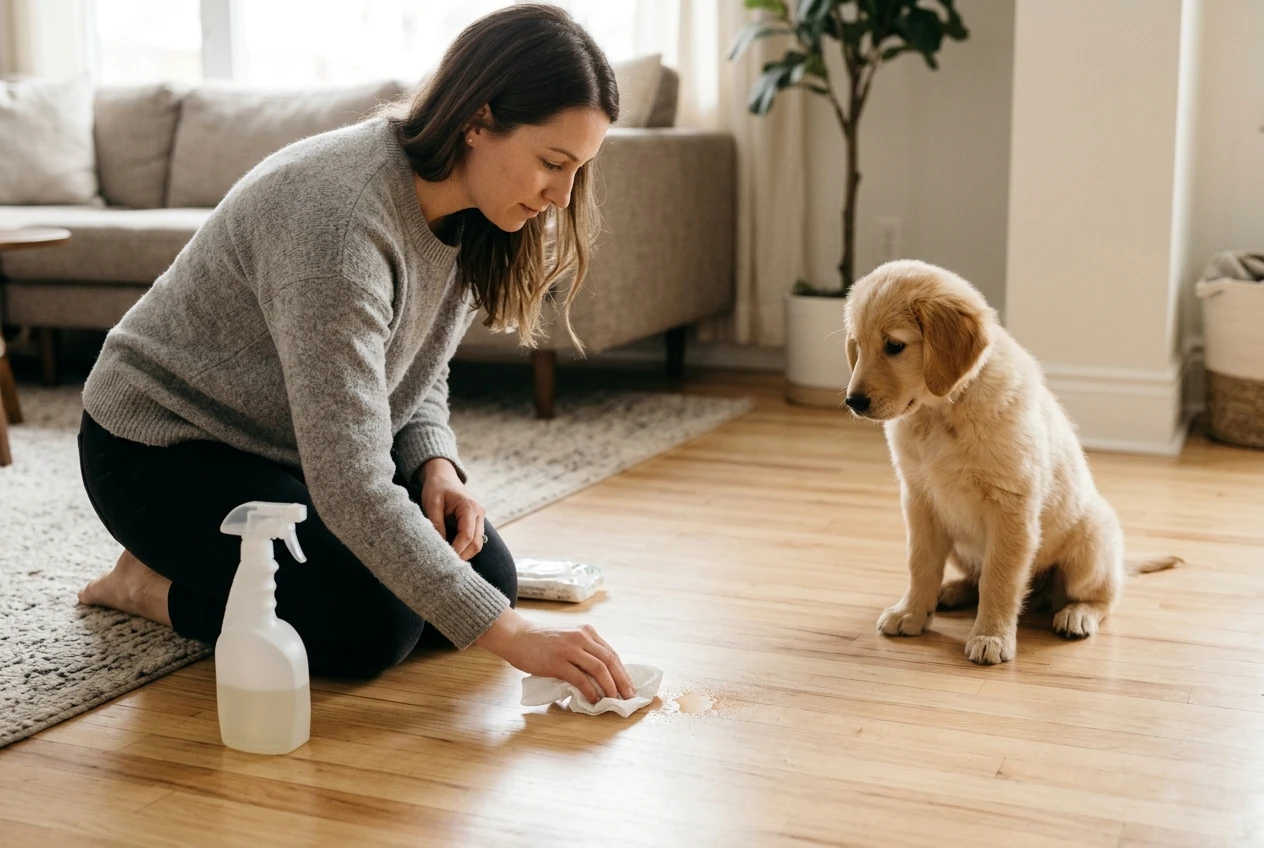
Skip the scolding
Puppies don’t connect a scolding with something they did a minute ago. What they may learn instead is that going to the bathroom in front of you is unsafe, so they begin sneaking off to hide it. That makes the supervision in Step 2 harder and delays the whole process. If you catch your puppy mid-accident, calmly interrupt them with a neutral sound, pick them up and carry them out to the right spot. If they finish there, reward them. If you find the mess later, there is nothing to correct. Clean it up and move on.
Clean it properly
Dogs tend to return to places that smell like a bathroom. Regular household cleaners may not remove the smell a puppy can detect, so many owners use an enzymatic cleaner made for pet messes, which is designed to break down the odor-causing material. Follow the directions on the label, and test it on a hidden area first if the surface is delicate. Avoid products with strong ammonia smells, since urine itself contains ammonia and the scent can draw a puppy back.
Ask what happened
This is where treating accidents as information pays off. Each time, run through a few quick questions:
- When was the last trip outside?
- Was the puppy being watched, or loose and unsupervised?
- Had they just eaten, drunk, played, or woken up?
- Did the signals show up, and did anyone notice?
- Was there a change in routine, such as visitors, a new room, or a longer stretch between trips?
Usually the answer is obvious and the fix is simple: a trip earlier, a gate closed, a closer eye. Write the answer in a notebook or on your phone if it helps. After a few days you will see patterns that tell you when to adjust the schedule.
Reset and carry on
After an accident, go straight back to the plan. Don’t shorten the leash on your own mood, and don’t make the puppy “pay” for it with less freedom for days. Take the next scheduled trip, reward the right spot, and keep going. A short setback is part of the process.
What a realistic first few weeks can look like
No two puppies follow the same timeline. Age, breed, size, previous living conditions, and individual personality all play a part, so any promise that a puppy will be fully trained by a certain date should be treated with caution. What you can expect is a general shape.
In the first days, you are learning your puppy’s rhythm and they are learning the routine. Expect frequent trips and a fair number of accidents. This is the stage where most of the work is yours, and the puppy is mostly absorbing the pattern.
Over the following weeks, you often notice that the accidents become less frequent and the gaps between trips can slowly stretch. Your puppy may start heading to the door on their own or looking at you in a way that makes sense once you know their signals. Don’t treat one clean week as a finished job, though. Puppies often have regressions, especially during changes like a new home, a different schedule, or a growth spurt in energy.
Keep the routine in place for a good while after things look settled. Most owners find that it is better to loosen it slowly than to drop it abruptly.
When to ask your vet
Some house training problems are not about training. I’m not a vet and can’t diagnose anything, but it is worth calling your vet if you notice any of these:
- Repeated accidents despite a consistent routine
- A puppy who was doing well and suddenly starts having accidents again
- Signs of discomfort when urinating or passing stool
- Very frequent urination, or unusual changes in how much your puppy is drinking
- Blood or anything unusual in urine or stool
- Diarrhea or loose stool that continues
Your vet can check for medical causes and tell you whether what you are seeing fits your puppy’s age. It is much better to ask early than to keep adjusting a training plan for something that needs treatment.
Tools that make the routine easier
You can house train a puppy with very little equipment, but a few items make the daily routine smoother.
- A crate or playpen. Gives the puppy a safe place when you can’t supervise. Choose a size that suits the puppy, and look for one with a divider if you want it to fit as they grow.
- Baby gates. Let you limit the puppy to one or two rooms and keep sightlines clear.
- An enzymatic cleaner. Handles accidents on floors and carpet so the smell doesn’t invite a repeat.
- A leash and a few small treats by the door. The sooner you can start the trip, the more likely the puppy is to finish in the right spot.
- Enrichment toys. Chew toys and treat-dispensing toys help a puppy settle in a crate or pen. A puppy occupied with a toy is also less likely to get anxious or bored, and boredom tends to make a puppy restless. Pick toys sized appropriately for your puppy and take them away if the puppy starts breaking off pieces.
- A notebook or phone app. Useful for tracking meals, trips and accidents so patterns are easy to see.
Skip anything that promises to train the puppy for you. Tools support the routine, but the routine itself is what teaches.
Keeping the follow-through going once the accidents slow down
The hardest part of house training for many owners is staying consistent after things start going well. The first few weeks are intense, and a good stretch can tempt you to relax the plan. A puppy who has gone several days without an accident has not yet mastered the habit, only practiced it for a short time.
A few habits help the routine last:
- Keep the schedule for meals, outings, and bedtime steady, even on weekends.
- Give new freedom in small pieces. Open one extra room for a short time, and if all goes well, extend it.
- Keep rewarding for a while, then reduce treats gradually and keep up the praise.
- Share the job if you live with others. Everyone should use the same cue words, the same spot, and the same rules so the puppy doesn’t get mixed messages.
- Expect the occasional slip and respond the same way every time: clean up, ask what changed, adjust, and carry on.
Consistency is the thing a puppy cannot learn without, and it is the part you provide. If you are raising a puppy and want the same steady approach for the basics that come next, I wrote about it in From Chaos to Good Dog.
If you want help turning this routine into a habit for both of you, take a look at the online dog obedience classes, which pick up where house training leaves off and walk you through the next puppy basics.