
If you have a puppy on the way, or one asleep in a crate beside you right now, you have probably wondered whether you’re starting obedience training too early or too late. Both worries are common, and both rest on the idea that there is a single correct age.
There isn’t! Your puppy starts learning the day they come home, and what changes as they grow is what you can reasonably ask of them. I’m a lifelong dog owner with years of obedience, agility and water work behind me, and I’m not a certified trainer. What follows is what long experience with dogs has shown me, plus a plain walk through the stages.
Why the “right age” question has a better answer than a number
Puppies are learning from the first hour in your house. They learn that the door opens when they bark, that jumping up gets attention, and that coming when called is either wonderful or irrelevant. Whether or not you call it training, your puppy is already being taught.
So the useful question is what to ask of a puppy at this age, and how to do it so the lesson sticks. A twelve-week-old can’t hold a ten-minute stay, and a seven-month-old can learn a lot more than a puppy’s first lessons. Match your expectations to the stage and you will rarely be too early or too late.
Daily consistency matters more than any starting date. Three minutes a day, every day, from the first week will get you further than a burst of serious sessions that starts at a “proper” age and fades after a month.
The first weeks at home: short, happy lessons count as training
Your puppy’s first days are mostly about settling in. Even so, a surprising amount of real training fits into them without a formal session.
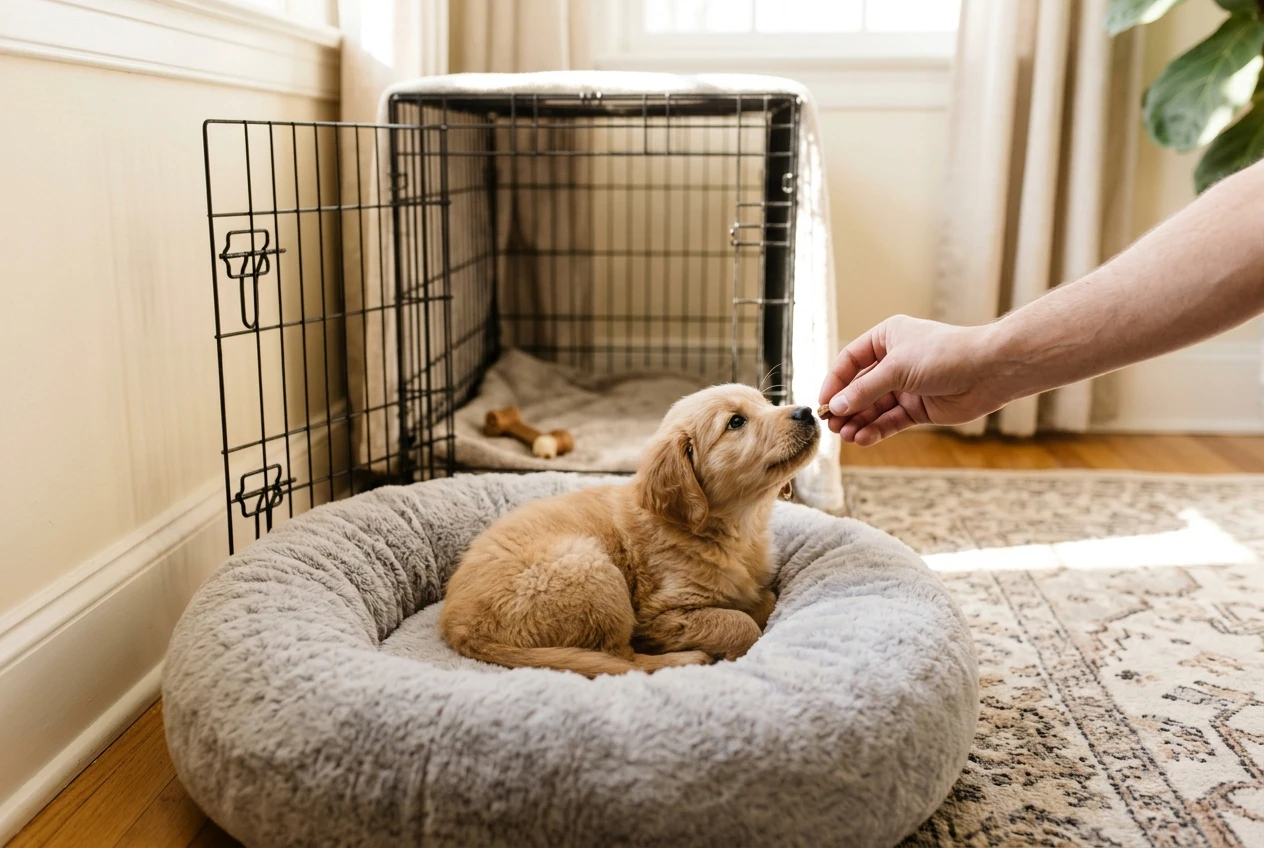
Start with things that feel like ordinary life:
- Say your puppy’s name in a cheerful voice, then give a small treat. Do this many times a day.
- Reward calm moments, like lying quietly on a bed, so they learn that settling pays.
- Take your puppy out to their toilet spot at predictable times. Our guide on how to house train a puppy in four steps covers this routine in detail.
- Handle their paws, ears and collar gently while rewarding them, so grooming and vet visits are less stressful later.
- Introduce the crate or bed as a nice place with a chew or a food toy.
Keep every interaction short and upbeat. A puppy this young tires quickly and loses interest fast, so a minute or two is plenty. If your puppy wanders off, the lesson was long enough.
Eight to twelve weeks: tiny sessions, name games and good habits
Many puppies come home at around eight weeks, which is also when formal-feeling lessons can begin, as long as they are tiny. Think one to three minutes at a time, several times a day, ending while your puppy is still keen.
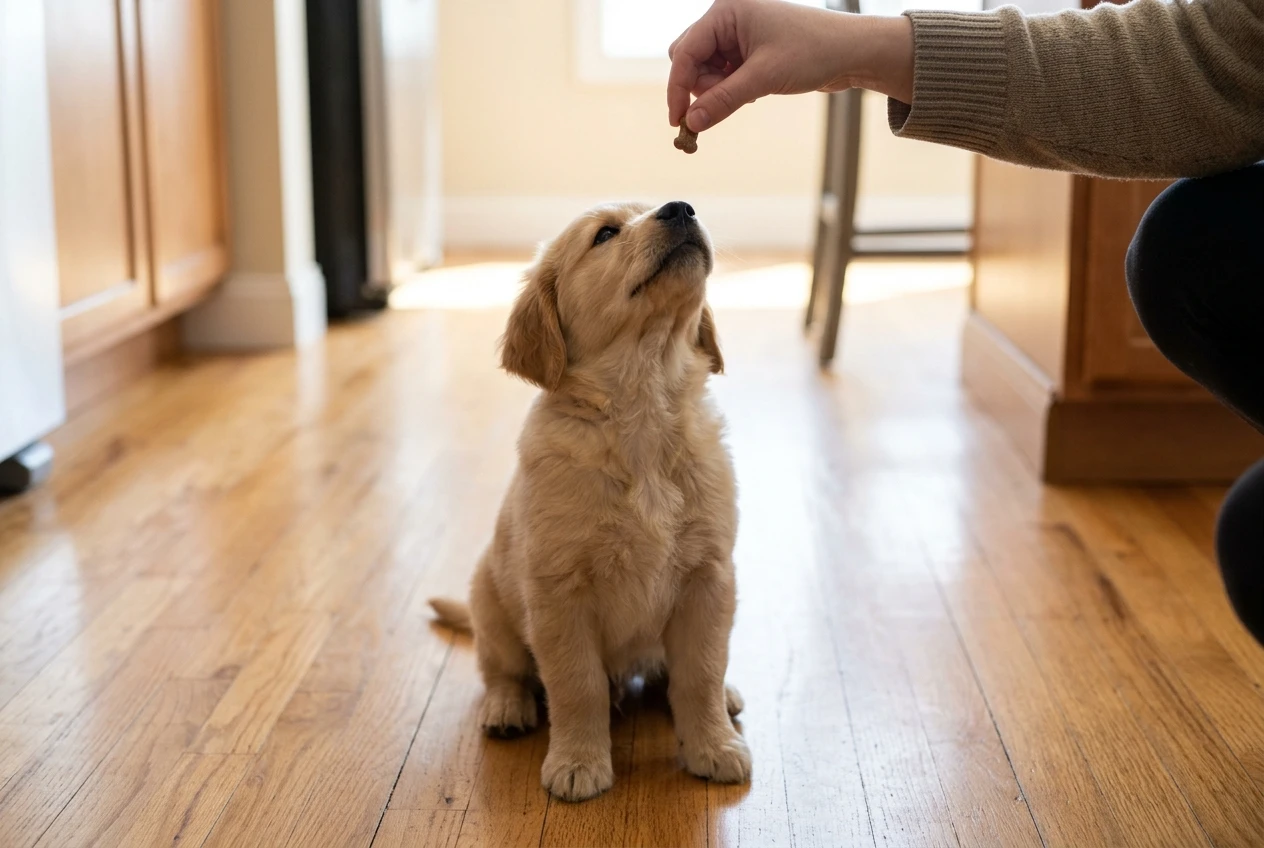
At this stage you are building the foundations that later commands rest on:
- Name game. Say the name, and when your puppy looks at you, reward. This teaches that your voice means something good is coming.
- Sit. Hold a treat just above the nose and move it slightly back over the head. Most puppies sit naturally, and you mark the moment and reward it.
- Come. Crouch down, say their name and “come” in a bright tone, and reward generously when they arrive. Practice indoors, where there is little competition.
- Hand touch. Present your open palm and reward your puppy for touching it with their nose. It gives you an easy way to move them around and redirect attention.
- Wait at doors and before meals. A moment of patience before the bowl goes down or the door opens is a habit that costs you nothing to build.
The commands themselves matter less than the habit of paying attention to you. If you want a list of what to teach first, the five basic commands to start on day one is a good companion to this section.
Use food or a favorite toy as the reward, and expect lots of mistakes. A puppy that sits for one second has done the job.
Four to six months: when focus gets shaky and consistency pays off
Somewhere around four months, many owners notice a change. The puppy who sat so nicely in the kitchen now ignores you in the yard. Teething can make them distracted and mouthy, and their energy and curiosity both increase. Nothing is wrong. Distraction is a normal part of this stage, and your puppy’s attention span is still short.
This is the point where consistency starts to show its value. Puppies who have practiced a little every day usually keep a thread of what they know, even when their focus wobbles. Puppies who haven’t practiced have to start almost from scratch.
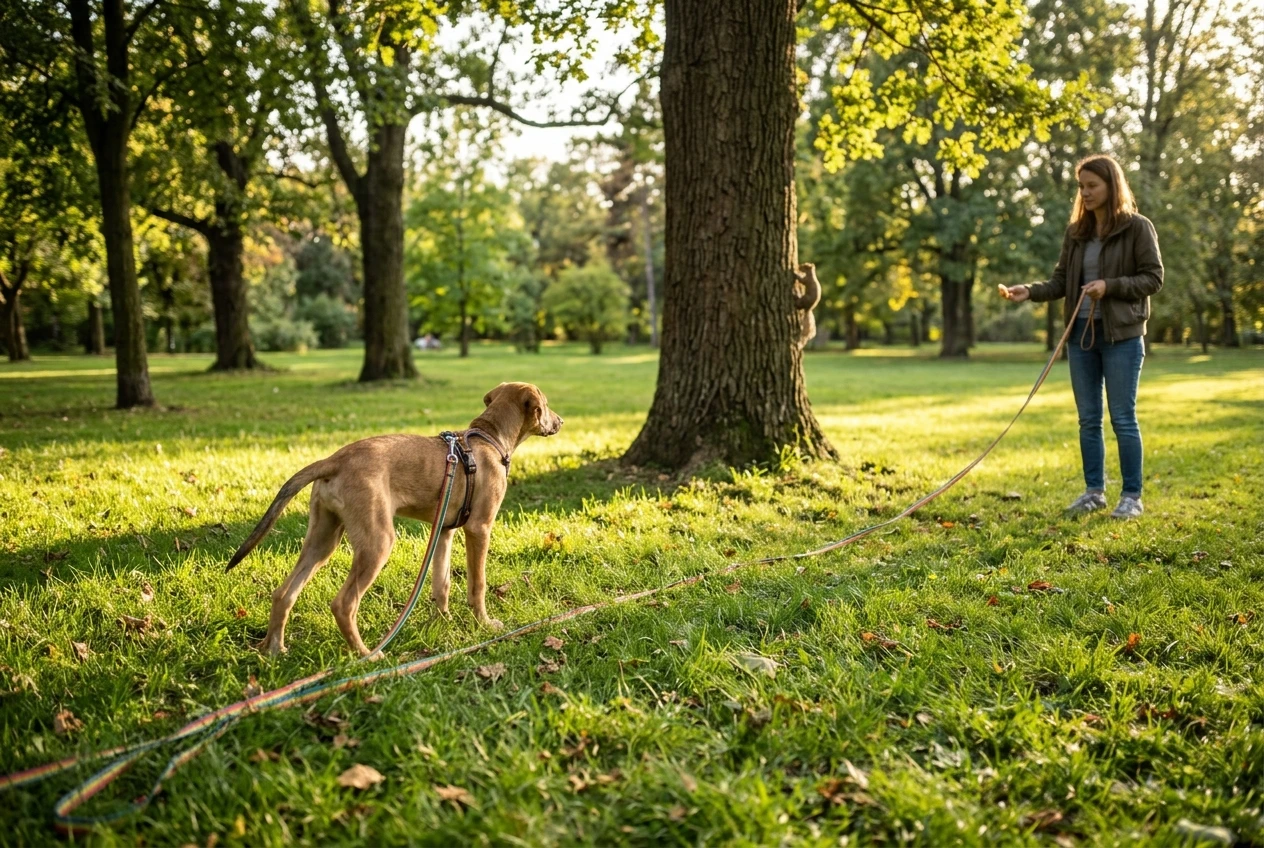
Here is what helps at this stage:
- Go back a step when a skill falls apart. If “sit” fails in the park, practice it in the hallway again, then build up.
- Raise the value of the reward when the environment is harder. A piece of chicken beats a dry biscuit when there are squirrels about.
- Add one new challenge at a time. Increase distance, duration or distraction, but never all three at once.
- Teach down, stay and loose-leash walking in short sessions, still in easy places.
- Use a long line for recall practice in open spaces so your puppy can’t learn that ignoring you is an option.
- Let your puppy burn off some energy before training. A calm, tired puppy learns better than a wired one. Ask your vet how much exercise suits your puppy’s breed and age, since this differs especially for large breeds.
Keep sessions short even now. Five minutes is a long training exercise for most puppies of this age.
Adolescence: why your once-perfect puppy suddenly “forgets” everything
Adolescence, which can start in the later months of the first year and varies a lot between dogs and breeds, is when many owners decide that all their effort was wasted. The puppy who was so reliable begins to ignore known cues, pulls on the leash, or bolts out the door.
Your puppy hasn’t forgotten anything. Their body and brain are changing, they are more interested in the world than in you, and they are testing what still works. Skills that were solid at four months can look shaky at nine, and then return.
What gets you through is staying steady:
- Keep the daily routine going, even if sessions feel like they accomplish little.
- Lower your expectations temporarily and ask for easier versions of known skills.
- Keep rewarding the behavior you want, including the small wins.
- Manage the environment, such as keeping a leash on in unfenced areas, so your puppy can’t practice the wrong habits.
- Resist the urge to get harsher. Pressure usually makes this stage longer and more stressful. If you’re unsure about methods, reward-based versus dominance training looks at what each approach looks like when a puppy won’t listen.
Owners who stick with the routine through this stage usually find their dog settles into a dependable adult. Owners who stop tend to find they have to rebuild later.
What about an older dog or a rescue that missed all of this?
They haven’t missed their chance. Dogs keep learning throughout their lives, and an adult dog can pick up new skills, often with a longer attention span than a puppy has.
A few points apply specifically to dogs who join you later:
- Give a rescue time to settle. A new dog may need days or weeks to feel at home before they can focus on lessons. In that time, keep the routine predictable and the demands light.
- Start with the same basics a puppy would learn: name, sit, come, settle, and polite walking. You are building a relationship as much as teaching commands.
- Assume nothing about their history. Treat every skill as new until they show you otherwise.
- Mention sudden changes to your vet. If a dog who used to do something stops doing it, or seems uncomfortable during training, a vet can tell you whether there’s a physical reason.
Short sessions with rewards work for a three-year-old rescue just as they do for a three-month-old puppy.
A simple weekly rhythm you can actually keep up with
A routine you can maintain will do more than an ambitious plan you drop. This is a rhythm that fits around most households, and you can adjust it to your dog’s age and your schedule:
- Every day: two or three sessions of two to five minutes each, depending on age. Use mealtime, since food is an easy reward, or pause during play.
- Three times a week: practice one skill somewhere with mild distractions, such as the yard, the front step or a quiet street.
- Once a week: pick one new thing to introduce, like a stay or a hand touch, and spend the week building it.
- One day a week: keep training light. Offer a food puzzle or other enrichment toy, play, and let your dog rest.
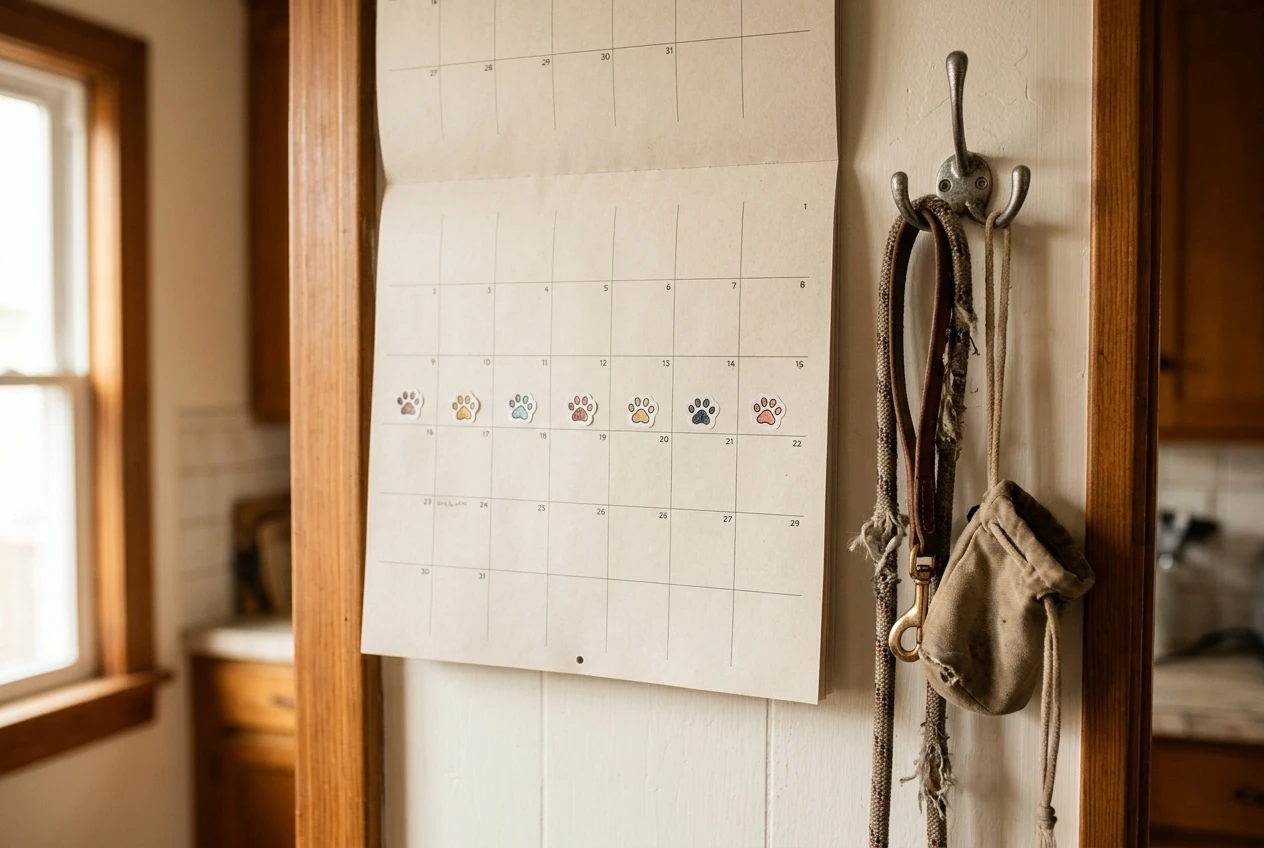
Write what you practiced on a calendar. Seeing a run of marked days encourages you on a day you’d rather skip, and it shows progress when your dog’s behavior seems to stall.
Make sure everyone in the household uses the same words and the same rules. If one person lets the puppy on the sofa and another doesn’t, the puppy learns that rules depend on who’s around.
When a class helps: group and online options and what to look for
Plenty of owners manage well on their own, but a class can add structure, expert feedback and a reason to keep going. Group classes give your dog practice around other dogs and people, and you can see how other owners handle the same problems. Online classes suit people whose schedules are unpredictable, and you can repeat a lesson as often as you need.
Whichever you choose, look for:
- Reward-based methods. Check that the instructor uses treats, toys and praise, and explains why.
- Small class sizes, so you get real attention rather than a crowd.
- Clear, step-by-step lessons that build, with a sensible pace for your dog’s age.
- Feedback or support, whether from a trainer in the room or a way to ask questions online.
- Openness. You should be able to ask what a class covers before you commit.
If a class asks about vaccinations before your puppy attends, that is normal. Check with your vet about what your puppy needs first.
If you want that structure and accountability, take a look at online dog obedience classes. They are a practical way to follow through on a consistent routine, whether your dog is eight weeks, eight months or eight years old.

“The single greatest cause of death in dogs under one year of age is not Parvo,
it’s not Distemper, it is lack of obedience training and 93% of training and
behaviour problems can be solved using a series of simple dog training techniques”